Showing posts with label select. Show all posts

The number of columns for each row in a table value constructor must be the same

What is table value constructor?

A set of row value expressions to be constructed into a table.

It can be specified/Used in the following forms
  • VALUE Clause in INSERT
  • VALUE Clause in SELECT..FROM
  • VALUE Clause in MERGE..USING
  • VALUE Clause in JOIN
The number of values specified in each list must be the same and the values must be in the same order as the columns in the table.

Usually, We need to use UNION or UNION ALL for Non-Table result set. Right ?
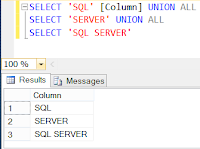


But, The same thing can be achieved by Table value constructor as below 
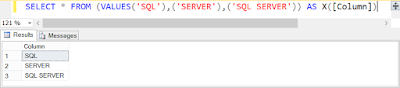

And, The number of values specified in each list should be matching!! 

If not - We can see the below Error


Msg 10709, Level 16, State 1, Line 1
The number of columns for each row in a table value constructor must be the same.

SELECT COUNT(*) - Always scans all the pages/rows ?

SELECT COUNT(*) always scans every rows (all pages/rows) in the table ?

No! - Not exactly! First, Ask the question - "The table has any Index ?"

How many Index are there in that table ? Each column type/size (allocation) ?

Why should I ask these questions ?

Here is the scenario!

A table "SystemObjects" created along with 2062 records
SELECT [schema_id], CAST([object_id] AS BIGINT) [object_id] , CAST(name AS NVARCHAR(200)) [name] INTO SystemObjects 
FROM sys.system_objects

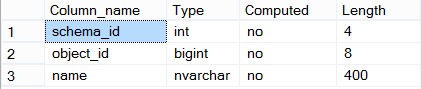
Table structure:


Trying to get record count (with Actual Execution Plan)

SELECT COUNT(1) FROM SystemObjects


YES! - Now, we got Table Scan operation with 94%. Yeah - This is what always happen right ?
Partially Yes and No!

Lets create a Non-Clustered Index:
CREATE NONCLUSTERED INDEX nci_obj_id ON SystemObjects([Object_id])

- Non-clustered Index has been created on Object_id column which is 8 Byte!

Trying to get record count (with Actual Execution Plan)

SELECT COUNT(1) FROM SystemObjects


We got Index Scan operation based on object_id column

Lets create an another Non-Clustered Index:


- Non-clustered Index has been created on schema_id column which is 4 Byte!

Trying to get record count again (with Actual Execution Plan)

SELECT COUNT(1) FROM SystemObjects


We got Index Scan operation again. But, this time based on schema_id column!!!

Confusing a bit right ?

See - How the Optimizer decides and goes based on what condition ? You believe Optimizer always tries to go with low cost. right ?

here is how...

Lets explore the current internal structure:
SELECT a.name, b.index_id, b.page_count, b.index_type_desc FROM sys.indexes a cross apply sys.dm_db_index_physical_stats(DB_ID(), a.[object_id] ,a.index_id,NULL,'LIMITED') AS b
WHERE a.[object_id] = OBJECT_ID('SystemObjects')


As you can see, The optimizer chooses to get the info from the smallest structure which will cost very less!!! right ? (Performance perspective)

here - The Optimizer decides to go with lowest pages to process with - So that the whole operation completes quickly/costs very less. Which is very effective/optimized operations.

The optimizer goes with "nci_schema_id" Index which is least pages (5 Pages)

If you remove the Index "nci_schema_id", The optimizer goes with "nci_obj_id" index which is least pages (6 Pages)

Once remove all the Indexes from the table - There is no other go - The Optimizer goes with Table scan (Scans all the Pages - 22 pages)

Here is the synopsis: The Optimizer goes with least pages which can be complete the process as quickly as possible with less cost!

A SELECT statement that assigns a value to a variable must not be combined with data-retrieval operations

Data assigning and Data retrival can not be used in a same statement.

/*Creating a table*/
If OBJECT_ID('Tb_Sample1') Is Null
Create Table Tb_Sample1
(
Id Int Identity(1,1),
Col1 Varchar(10),
Col2 DateTime
)
Go


/*Inserting one record*/
Insert Tb_Sample1(Col1, Col2) Values('SQL Server',CURRENT_TIMESTAMP)
Go


/*Using Data assigning and Data retrival in same statement*/
Declare @Column1 Varchar(10)
select Id, Col2,@Column1 = Col1 from Tb_Sample1
Select @Column1


Id, Col2 - is the retrival part
@Column1 = Col1 - is the assigning data to variable, These both operations can not be used in a single statement

It'll throw an error...
Msg 141, Level 15, State 1, Line 2
A SELECT statement that assigns a value to a variable must not be combined with data-retrieval operations.